
AI consulting and product development — working agents on your systems in weeks
We build and operate production AI: LLM assistants, autonomous agents, and automation pipelines — deployed on your systems with human-in-the-loop guardrails. We run our own business on them, so you get working software, not slideware.
AI consulting & LLM development overview →
AI agents, in production
We do not demo AI — we run it. Everything below is a system we built and operate ourselves, on real data, with human review where it counts.
A deployed LLM assistant inside our Civic Suite municipal platform — OpenAI-powered, answering staff questions through a read-only tool contract over ERP-derived data.
An agent pipeline that researches, writes, illustrates, and publishes a new article every weekday on a schedule, with editorial guardrails.
Thirteen production websites on one cluster and one automated path: CI/CD, SEO verification, content, and monitoring. Agents draft the changes and drive the checks green; a human gates every merge.
Discovery and enrichment engines with signal scoring and learning loops that prioritize our own pipeline continuously.
AI Agent Sprint — your first working agent in about two weeks, fixed scope set from a 30-minute call.
Deep municipal roots: Tyler Munis & EnerGov reporting, dashboards, and audit readiness for cities, counties, and utilities — municipal services, Munis consulting, and AI for local government.
Breaking Data Silos Across ERP, Grants, and Department Systems
Cities, counties, and utilities tell us the same story: disconnected systems, difficult reporting from Munis or EnerGov, manual spreadsheet workflows, and no integrated view for leadership. We help you replace shadow bridges with governed definitions, shared dimensions, and reporting pipelines finance and departments can trust together.
Reports that break when someone retires, schemas change, or an ERP upgrade lands. No documentation, no fallback.
Spreadsheets, copy-paste, and weekend reconciliations that consume staff time and introduce error risk.
Scrambling for documentation, validating data lineage, and explaining gaps when external auditors arrive.
Reports that run for hours, time out, or block other users. Aging SQL, missing indexes, no tuning.
One person knows how the reports work. When they leave, institutional knowledge leaves with them.
Staff drowning in repetitive document work while leadership asks for AI pilots—with no policy, no data cleanup, and vendor demos that skip public accountability.
Two ways we help
Expert AI and LLM consulting for businesses and local government: agents that do real work, LLM product development, and governance—deployed on your systems with human review.
Explore AI consultingData quality, audit-ready reporting, modernization, and retainers—so finance and IT get reliable numbers from Munis, EnerGov, and SQL Server without fire drills.
Explore municipal systemsMunicipal Reporting Stability and Audit Readiness
Audits do not create reporting problems—they reveal fragile workflows and undocumented logic. We focus on the work that makes decision information reliable when controls, reconciliations, and review cadence are tested under pressure.
reduce reporting risk before audit fieldwork — practical steps for data quality, evidence packs, and cross-system consistency before fieldwork intensifies.
Programs and engagements
Outcomes that reduce reporting risk and audit scramble. See the full services overview.
Inventory and strengthen reporting systems, data pipelines, and query performance.
Learn moreSSRS, SQL Server, and custom reports that work with Munis, EnerGov, and your ERP.
Learn moreConnect ERP, billing, and operations systems with reliable data refresh.
Learn moreData Quality Management and Controls Evidence
Data quality is the operating system behind audit-ready reporting: definitions people agree on, rules that catch defects early, lineage from source to council packet, and evidence you can retrieve when questions arrive months later.
learn data modernization tactics — a municipal-first guide to frameworks, lineage, silo reduction, and a 90-day rollout sequence.
Municipal systems we know
We work in the platforms cities and counties run every day—so your reporting, integrations, and data pipelines are in capable hands.
Munis financials, reporting, data extraction, and integration. ERP and Tyler ecosystem optimization.
EnerGov implementation, reporting, and data workflows for permitting, licensing, and government operations.
Billing data, reporting, and pipelines for municipal utilities and authorities.
SSRS, query optimization, and SQL Server environments common in municipal IT.
Municipal time and attendance, payroll integration, and related reporting.
Budgeting, reporting alignment, and integration between OpenGov and systems of record.
Additional ERP and civic systems—scoped and prioritized after we understand your environment.
Consulting by topic
Dedicated pages for the systems and problems city and county teams search for—Munis, utility billing, OpenGov, EnerGov, ERP integration, and reporting.
How a Municipal Systems Assessment Works
Not sure where to begin? Start with a Municipal Systems Assessment—or the companion AI Readiness Assessment if document workload and AI policy are the pressing questions.
- Review of reporting systems — What you have, what’s fragile, and what’s missing.
- Evaluation of data pipelines — Where data comes from, how it flows, and where it breaks.
- System integration analysis — How Munis, EnerGov, and other systems connect (or don’t).
- Written improvement roadmap — Prioritized next steps: risk assessment, optimization, or retainer.
The retainer model: Stability over reactive fixes
Municipal retainers are designed for continuity—not one-off projects. You get predictable access, clear expectations, and a partner who understands your systems over time.
Ongoing relationship that survives staff turnover and ERP upgrades.
Defined response times, scope boundaries, and delivery cadence.
Proactive guidance on reporting architecture, data quality, and audit preparedness.
Prevent issues before they surface, rather than scrambling when audit season arrives.
Measurable outcomes
Case study–style results from municipal engagements. Quantifiable improvements in reporting performance, audit readiness, and operational stability.
55% reduction in monthly reconciliation time after query optimization and report refactoring.
Legacy SSRS reports were timing out; manual Excel workarounds consumed 40+ hours per month.
Audit-ready documentation and automated validation for a utility authority's billing reports.
Previously, external auditors required extensive manual verification of data lineage.
Consistent data refresh and reduced staff dependency for a mid-sized city's financial reporting.
Single staff member had been the sole owner of critical reporting processes.
Civic Suite — portal and dashboard together
When residents pay bills, file 311 requests, or apply for permits on your city site, staff see those events in the operations dashboard—one dataset, one closed loop. Explore the fictional live demos or book a walkthrough.
Learn about Civic SuiteDemo city siteDemo dashboard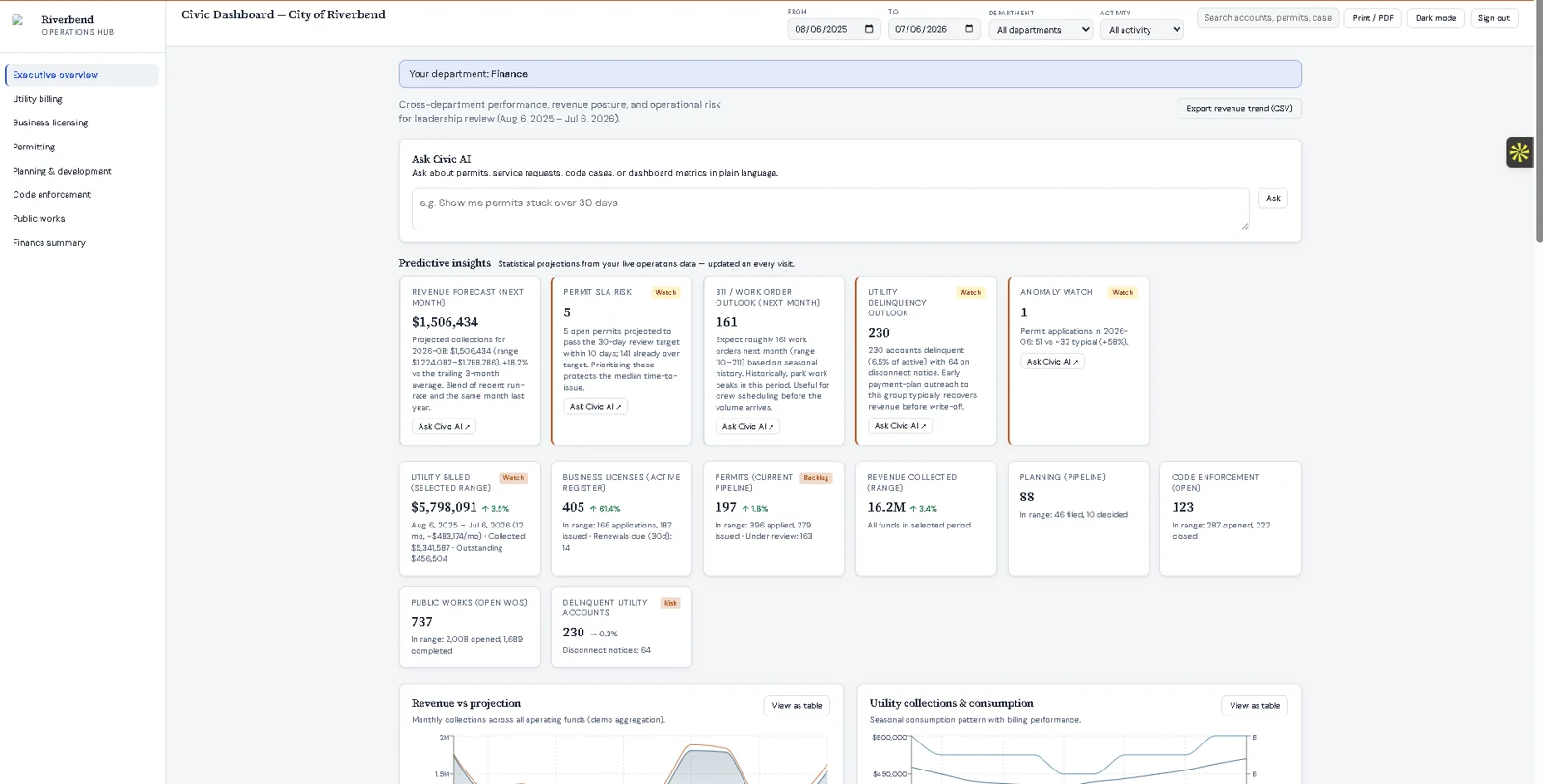
Civic Dashboard
Transparency and executive analytics for municipalities—budgets, services, and community data in one accessible dashboard. Built on your existing Munis and EnerGov data.
Learn about Civic Dashboard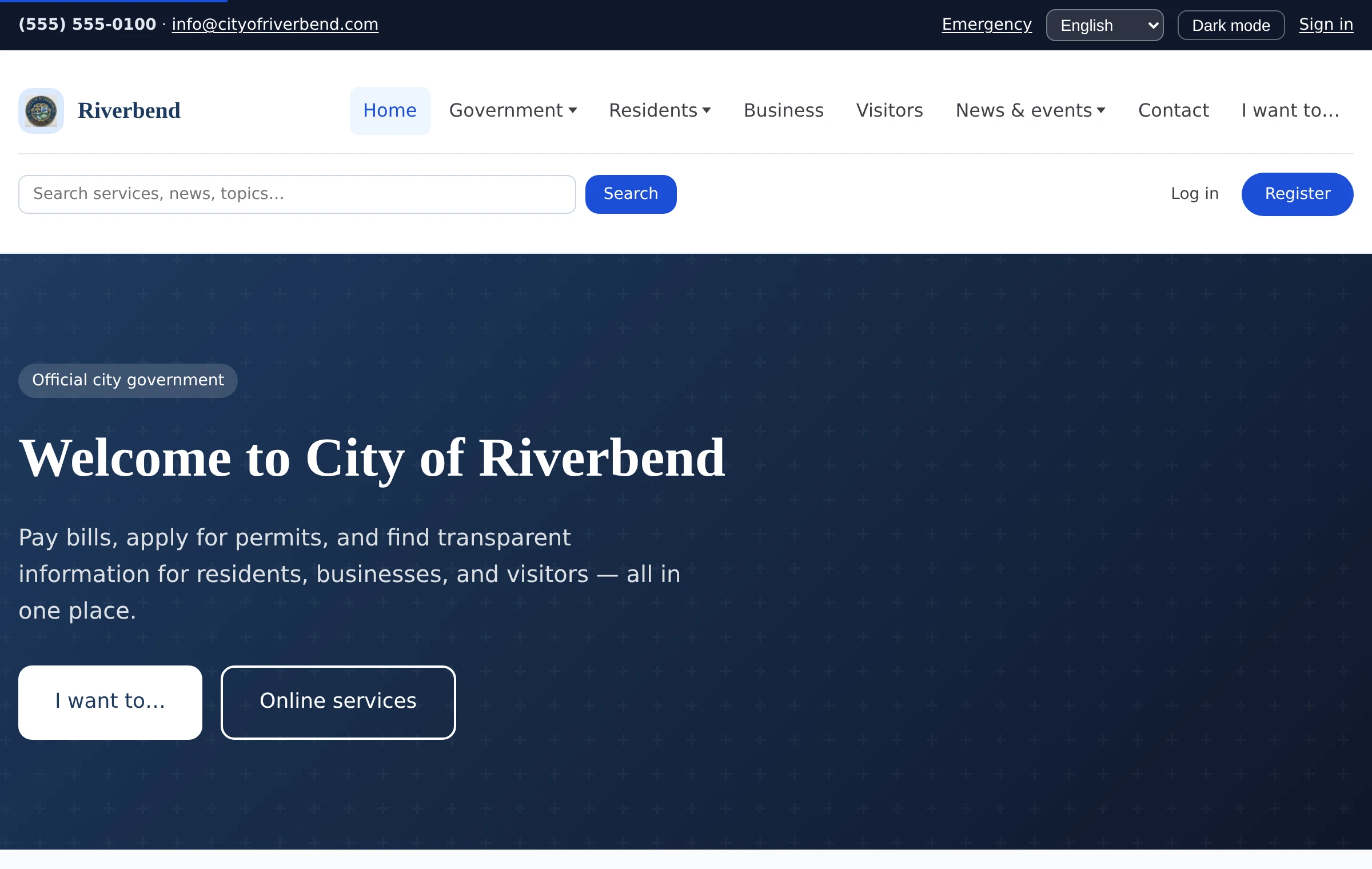
Municipal website development
Resident-facing city and county sites—online services, permits, bill pay, and WCAG-conscious design. See our reference build, City of Riverbend.
Municipal website developmentCustom development for government
When portals, integrations, or SQL/SSRS work is the right next step, we build on the municipal data layer you already have—portals, pipelines, and dashboards measured by operational outcomes, not lines of code. Municipal technical consulting and data modernization describe typical scopes.
Strategic partner, not vendor
Innovation Nexus is led by a deep municipal data specialist—SQL and reporting expert, infrastructure-aware developer, and strategic partner for cities, counties, and utility authorities.
We combine hands-on SQL Server optimization, SSRS report engineering, ERP integrations, and full-stack development with a focus on operational stability. The goal: reduce risk, improve audit readiness, and deliver continuity that outlasts staff turnover.
Learn more about our teamFrequently asked questions
How fast can you get an AI agent into production?
Typically a first working agent in about two weeks, on a narrow, well-scoped workflow, with human-in-the-loop review before anything is final. Scope is set on a 30-minute call, then we build against your real data rather than a demo dataset.
Do we have to replace our current systems to use AI?
No. Agents run against the systems you already have — including Tyler Munis and EnerGov — reading and writing through supported interfaces. Your data stays where it lives; we add the automation and review layer around it.
What does Innovation Nexus specialize in?
Innovation Nexus specializes in AI consulting and AI product development — AI agents, LLM-powered assistants, and automation deployed on your systems — alongside deep municipal systems expertise: Tyler Munis and EnerGov reporting, data modernization, and audit-ready controls for cities, counties, and utility authorities.
Do you work as an ERP consultant or ERP implementation consultant for municipalities?
Yes. We act as an ERP consultant and ERP implementation consultant in the local-government context—helping cities and counties connect finance, utility billing, and operations systems; stabilize reporting; and support go-live and post-implementation work on platforms such as Tyler Munis and related municipal ERP software.
Do you support municipalities outside of South Carolina?
Yes. Innovation Nexus delivers municipal data and systems support across the United States, with an on-the-ground presence in Florence, South Carolina and the Pee Dee region.
What technologies do you work with for municipal reporting?
We specialize in SQL Server optimization, SSRS report engineering, ERP integrations, cloud infrastructure, and full-stack development (React, .NET) to support municipal modernization.
What municipal software and platforms do you support?
We have strong experience with Tyler Technologies (Tyler Tech), Energov (EPL), Munis, Time and Attendance, and other municipality-centered ERP and operations software. We support reporting, integrations, and optimization across these platforms.
How does the municipal retainer model work?
Our retainers provide ongoing data and systems support with clear SLAs, strategic advisory, and continuity. We focus on stability rather than reactive fixes—reducing audit stress and staff dependency.
Ready to reduce reporting risk?
Schedule a 30-minute Municipal Systems Assessment. No obligation—just clarity on next steps.